Saturday, December 24, 2011

Orphanage Visits in Myanmar

Pan Chan Gone Orphanage Monastery in Bago, Myanmar

Situated in the heart of the Bago town, this orphanage monastery houses about 120 orphanages, aging from 3 to 13 years old. All are boys. This monastery provides shelter to the children whose parents lost their life in the civil war near the Thai-Myanmar border in the eastern Myanmar.

We distributed about 170 sets of stationery and 150 sets of bags, children story books plus sticker books to the children. Before we left, we presented some cash donation contributed by friends from Malaysia and Singapore to the monastery.


Sate Phu Taung, Youth Welfare Development Center, Mon State, Kyaikhto Township, Myanmar

The next day, after our Golden Rock tour, we went to this mountain orphanage which provide food and education to about 636 children from needy families and orphans. During our visit there, we met a big group from Buddhist Mission, Singapore who donated food and clothing to the children. Following that, we were mesmerised by a tribal dance performance by the children from Karan Tribe. Four of us went around distributing sweets to the children to make them happy, and a short tour around the center too. This center covers an area of 81 acres. Children are from as young as 3 months old to the university grad. Some orphans came back to teach after graduating from their teacher's training school.

As usual, before we left, we presented cash donation accumulated from the Malaysian and Singapore friends to Ven Jotika, the abbot of Seik Phu Taung monastery.


"A humane heart
of which loving kindness
and compassion flows
for which we deeply
appreciate and honour."
  

Saturday, September 3, 2011

Can someone attain liberation without meditation?


In one of the Dhamma talks by Bhante Henepola Gunaratana, a distinguished meditation teacher, at the Buddhist Library in Singapore, during the Q & A session, one of the audience asked Bhante this question: “Can someone attain liberation without meditation?” Bhante answered with reference to the five bases of liberation in which one’s mind could be liberated. I have no idea from which Sutta it is stated that way, but certainly it had created much interest not only me, but the Buddhist Library Spiritual Advisor himself to look for the source of the quotations.
Alas, finally, I’ve found it in the Aṅguttara Nikāya, V,26:

There are five bases of liberation:
1.      By listening to the Dhamma from a Teacher: When a certain monk in the position of a Teacher teaches the Dhamma to a monk, that monk experiences the meaning and the Dhamma. When he gains such experience gladness arises. When he is gladdened rapture arises; for one uplifted by rapture the body becomes calm; one calm in body feels happy; for one who is happy the mind becomes concentrated.
2.      By teaching the Dhamma to others: The monk himself teaches the Dhamma in details to others as he has learnt it and mastered it. That monk experiences the meaning and the Dhamma. When he gains such experience gladness arises…the mind becomes concentrated.
3.      By reciting the Dhamma: He recites the Dhamma in detail as he has learnt it and mastered it. As he recites the Dhamma, that monk experiences the meaning and the Dhamma. When he gains such experience gladness arises…the mind becomes concentrated.
4.      By investigating the Dhamma: He ponders, examine and mentally investigates the Dhamma as he has learnt it and mastered it. As he ponders the Dhamma, that monk experiences the meaning and the Dhamma. When he gains such experience gladness arises…the mind becomes concentrated.
5.      By concentration on certain object: He has learnt well a certain object of concentration, attends to it well, sustains it well, and penetrates it thoroughly with wisdom. As he learns well an object of concentration, that monk experiences the meaning and the Dhamma. When he gains such experience gladness arises…the mind becomes concentrated.

So, when a monk dwells diligent, ardent and resolute in any of the five bases, his unlibrerated mind comes to be liberated, his undestroyed taints undergo destruction, and he attains the as-yet-unattained unsurpassed security from bondage.

The key phrase that is common to all the five here, is “mind becomes concentrated”. Let’s take a look at what commentary has got to say on this: (pertaining to the first base) “As he listens to the Dhamma, he comes to know the jhānas, insight, the paths and fruits whenever they come up (in the course of instruction). When he knows them, rapture arises, and on account of that rapture he does not allow himself to backslide midway; rather, he brings his meditation subject up to the level of access concentration, develops insight, and attain arahantship. With reference to this it is said, ‘the mind becomes concentrated.’”

The purpose of pointing to this phrase is to examine if it is really that the bases of liberation, at least on the first four, has nothing to do with meditation. Perhaps, commentaries is not the ultimate point of reference as they are not the original Buddha’s words. Hence, falling back to my style, which is non other than resorting to examine the terms used in its original sense:
-          Concentration: The original Pāli word is Samādhi. “One who is happy the mind becomes concentrated (Sukhino cittaṃ samādhiyati)”. According to the Pāli-English Dictionary by Rhys Davids and William Stede, Samādhi means concentration; a concentrated, self-collected, intent state of mind and meditation, which, concomitant with right living, is a necessary condition to the attainment of higher wisdom and emancipation. (Samādhi exists in Hindu meditation as well, but the objective of the practice is different from that of the Buddha.)  
-          When we talk about meditation, conventionally, one will associate it with the practice of closing eyes with cross-legged and focusing on breathe. Well, that is a very narrow perception on this rich and broader sense of Buddhist path. It is natural for yogis and ascetics to sit cross-legged when practicing meditation, but it is not so in our time. Perhaps some may have misconception of it being too ritualistic and something mystic. Well, if that is not so, what then, is “meditation” really? When we trace to the original word spoken by the Buddha in which the translation comes from, it is often associated with “Bhāvana”. According to the dictionary, Bhāvana comes from the word “Bhāva” meaning being, becoming, condition or nature. It rarely appears on itself, so Bhāvana is a more meaningful term, which carries the meaning of “producing”, “dwelling on something”, “putting one’s thoughts to”, “application”, “developing by means of thought or meditation”, and “cultivating by mind”. Etimologically, it is said that the Buddha employs the term in the sense of cultivation, pertaining to the farmer performs bhavana when he or she prepares soil and plant a seed, in view of the agriculture background at the time of the Buddha’s dwelling. When it is discussed in relation to the cultivation of mind, this is where the term is used in a richer and deeper sense in comparison to the mere term of “meditation”. It carries the smell of earthiness, the ordinariness, suggesting that no matter how damaged a field have become, it can always be cultivated and enriched, producing satisfactory harvests – the results of cultivation! What do we actually develop and cultivate? It is the development of particular faculty that is intended to: Citta-bhāvana (development of mind/consciousness); Kāya-bhāvana (development of body); Metta-bhāvana (development of loving kindness); Pañña-bhāvana (development of wisdom); Samādhi-bhāvana (development of tranquil-wisdom - covering everything from worldview, to ethics, livelihood and mindfulness). The Theravādan teachers made us of both Samatha-bhāvana (development of tranquility) Vipassana-bhāvana (development of insight) which are added to the above.

What is the relation between Samādhi and Bhāvana then? Can Samādhi, as concentration be explicitly equated to Bhāvana as meditation? I was told that Bhāvana is the process, Samādhi is the result. In Samādhi, rupa and arupa jhānas are the results/fruits of sufficiently sustained concentration. Mind as the “earth” as mentioned above, in its stable condition – free of floods, parasites, and landslide, is a perfect “working place” (kammatthana) for crops cultivation. In the same sense, with a stable and concentrated mind, it becomes a fertile ground for the insights to take place and finally awakened to the true nature of the world.

Visit the five bases as expounded in the AN again, the first four are seemingly not related to meditation practice. But looking at them closely, each of them achieve the concentrated mind via “experience” (paṭisaṃvedī) on the wholesome knowledge he has gained. Take it for example the reciting of the Dhamma, we be reminded of the chanting of the name of Amitabha practice. Chanting (recitation) is the tool, developed and concentred mind is the result, and liberated mind is the fruition. This is “Bhāvana”, glamourly translated as “meditation”. We study the Dhamma, examine it, ponder on it – these are the means to cultivated mind. The whole process… is what we call “Bhāvana”. Bhāvana embodies all the five bases. It also runs through the whole Noble Eightfold Path. Hence, it is not limited to a particular way of folding the body or residing in a particular retreat centre. At the Buddha’s time, many liberated through hearing the Dhamma itself, or merely sweeping the floor. What is important here is what is really “at work”, at the right place and the right fruition will take place.

A Bhikkhu friend of mine told me this after consulting him regarding this topic: “Don’t just read the menu, can see cannot eat”. Similarly, don’t just look at the mere superficial meaning of words and terms, and examining the etimological meaning here and there – more importantly, understand it, experience it, and realise it!

References:
Pāli-English Dictionary by Rhys Davids and William Stede
Numerical Discourses of the Buddha: An Antology of Suttas from the Aṅguttara Nikāya. Translated and edited by Nyanaponika Thera & Bhikkhu Bodhi

Friday, January 14, 2011

Tiger's Dhammic Movie Review III: The Aging and Death of “Benjamin Button”

“At Sāvathi, King Pasenadi of Kosala said to the Blessed One: ‘Venerable sir, is anyone who is born free from aging and death?’ The Blessed One replied: ‘Great king, no one is born free from aging and death. Even those affluent khattiyas – rich, with great wealth and property, with abundant gold and silver, abundant treasures and commodities, abundant wealth and grain – because they have been born, are not free from aging and death. Even those affluent Brahmins… affluent householders – rich… with abundant wealth and grain – because they have been born, are not free from aging and death. Even those monks who are arahants, whose taints are destroyed, who have lived the holy life, done what had to be done, laid down the burden, reached their own goal, utterly destroyed the fetters of existence, and are completely liberated through final knowledge: even for them this body is subject to breaking up, subject to being laid down.
   The beautiful chariots of kings wear out,
   This body too undergoes decay.
   But the Dhamma of the good does not decay:
   So the good proclaim along with the good.’”

(excerpt from Sayutta Nikāya 3:3, translated by Bhikkhu Bodhi)

No one can escape aging and cheat death. Even with the advancement of the medical sciences today, you may only delay them, but not “skipping” them. Aging begins from the very moment we are born, and the more often we celebrate our birthdays, the closer we are to the day of death. Haha, I’m sure no one will ever like to hear this in his or her birthday celebrations!

The excerpt from the Saṃyutta Nikāya as illustrated above serves as the prolouge to a man called Benjamin Button. Who is Benjamin Button anyway? He is the main character in a very special film called “The Curious Case of Benjamin Button”, the winner of three 81st Academy Awards. In this movie, he is born with an extremely weird disease: he comes to the world with a body of an old man in his 80’s. But over the years he becomes younger physically even as he ages mentally, which is in the reverse of everyone else. Struggling with his extraordinary condition, he finds that it is becoming impossible for him to live together with his loved ones: his beloved woman, Daisy and their daughter, Caroline. He “enjoys” his youthful days towards the last few chapters of his life, and eventually dies as a baby in his beloved woman’s arms.

Benjamin Button is not a hero, he is not enlightened either. He is merely a normal person like any of us, gaining wisdom and insights throughout the years of various life experiences. Just like any of us, he is unable to stop the time. Reflect on what is illustrated in the excerpt of the sutta above: “no can ever escape aging and death”. But what does “aging and death” mean to Benjamin Button? He does not experience the usual aging process in the same of what we all have to go through. But for him, aging nevertheless is still happening “inside” him. In the film, Benjamin made a remark to Daisy stating that he looks young only in the outside. Youthfulness is only a statement of mind, given the maturity gained over the years, one would become more and more seasoned with life. Impermanence is one of the main characteristics of the world we live in, nothing in our fathom-long carcass can escape that.

It also seems that Benjamin is very much “immune” to the process of dying and deaths. Well, perhaps this is because he spent most part of his “childhood” life in a nursing home filled only with old folks who were at the doorstep of the end of their life. Nothing indeed was common than the news of death of those residents there. In the beginning, Benjamin thought that he was just one of them, but over the course of time, he felt that there’s something he did not have in common with those folks. He was later convinced that he was not heading towards the destined direction (aging and death), instead he gained more “will” and “energy” to live each day. The tragic death of Captain Mike in a battle with German U-boat and the unusual appearance of Hummingbird in the middle of ocean had somehow changed his understanding towards death. Surrounded by deaths at every corner of his life, he was not very much saddened by the demise of his long-lost biological father, and his beloved foster-mother, Queenie. But I guess we don’t really need a “shower of death” for us to understand life and the inescapability of death, certainly contemplating death meditation as taught by the Buddha does serve as a good tool to achieve that.

The unusual circumstance of Benjamin being aging backwards leaves a significant impact on the people around him. Quoting from a phrase in the movie trailer, “Life can only be understood backward, it must be lived forward”, surely that mirrors the fact that every single experience in our life becomes our real “teacher”. Daisy did earnestly hope to lead a normal life with Benjamin till the end, but eventually realised that she was too old for Benjamin who came back to meet her in a much younger appearance. Similarly in our daily life, we should learn how to let the bygones be bygones. If Daisy chose to cling on to her “good-old-days” with Benjamin, both would suffer. Grasping to the past does not help us to grow, it will only retard us from gaining wisdom in understanding life.

We tend to grasp at a lot of things in our life, from the food we eat to various social achievements in the society. Once, Captain Mike told Benjamin this: “You can be as mad as a mad dog at the way things went. You could swear, curse the fates, but when it comes to the end, you have to let go.” In the Mahādukkhakkhandha Sutta (MN 13), the Buddha rightfully testifies how attachment to sensual pleasures, form and feelings could lead to the downfall of many, and hence the removal or abandonment of desire and lust towards them would therefore lead to the escape of it. Likewise, a person whose beauty we once admire the most, being consumed by age and time, would then appear crooked, wrinkled, and at the end remains just a foul corpse lying lifelessness. But even in the case of Benjamin who is at the reverse, the conditionality of the whole thing works the same: he could not stop himself from growing younger, no one is able to live a normal life with him till the end. Reaching the stage of a pre-teen just hitting puberty, Benjamin could not even escape dementia which has robbed him of his memories, both long and short. No one can ever escape the reality of conditionality, be it the forward or “reverse” direction of aging! 

Somewhere in the movie, Benjamin remarked to Daisy, “I was thinking how nothing lasts, and what a shame that is.” To which she replies, “Some things last.” As exclaimed in the opening sutta, nothing in this world, as long as they are conditioned, can escape change and decay. But something lasts, something which stands the course of time. It is the everlasting Buddha Dhamma that resonate the timeless message of “All conditioned things are subject to decay…” 

Saturday, December 4, 2010

Meaningful Quote from a Friend of Dhamma

"I expect to pass through life but once.
If therefore, there can be any kindness I can show,
or any good thing I can do to any human being, let me do it for now,
for I shall not pass the same way again"

by Karuna Tan Hock Lin, 
PJK, Malacca, Malaysia


Comment: 
We do not step into the same river twice. We do not live the same way anymore even from this moment to the next moment. Human life is as precious as we can imagine it could be. Live to the fullest, be the heir of Dhamma, spread the fragrance of kindness to every corner of the world...

Tiger's Dhammic Movie Review II - Okuribito (おくりびと): Understanding Life Through Death


Summary of the movie plot:

Daigo Kobayashi is a devoted cellist in an orchestra that has just been dissolved and now finds himself without a job. Daigo decides to move back to his old hometown with his wife to look for work and start over. He answers a classified ad entitled "Departures" thinking it is an advertisement for a travel agency only to discover that the job is actually for a "Nokanshi" or "encoffineer," a funeral professional who prepares deceased bodies for burial and entry into the next life. While his wife and others despise the job, Daigo takes a certain pride in his work and begins to perfect the art of "Nokanshi," acting as a gentle gatekeeper between life and death, between the departed and the family of the departed. The film follows his profound and sometimes comical journey with death as he uncovers the wonder, joy and meaning of life and living. Written by Regent Releasing

The meaning of the Japanese word “Okuribito” is “the person that sees / sends (somebody) off”. Well, who is this person that sees somebody off? You might be tempted to think that, hmmm…. “sending somebody off / away”… that must be the person who are dear or very much related to the departed one. Nevertheless, this is not the case as seen in the movie we’ve seen justnow, Departure (Okuribito). Sending off (the departed ones) with dignity becomes the “profession” of Daigo, the “encoffiner”, the main character in the movie.

Even though this movie deals with death and the vocation of "encoffining", it delivers something even more than that. It is about the celebration of the dignity and value of human life. As a matter of fact, we all will come to the door-step of death at a certain point of our lifetime but how do you help grieving family members to pay their last respects to their loved one with dignity and respect?

This man, Daigo brings out the dignity and value of human life reflected via how he handles his encoffining job. Despite of being despised by the people in the movie, and despising the job himself in the beginning, he eventually sees that the whole goal is to help grieving families to say goodbye to their loved one with dignity and respect. Being as an art as well as science, encoffining seems to resemble the beautiful musics played from his cello. Daigo is now nothing less than skillful in pacifying the grieving families who witness the bodies of their loved ones treated with tender affection and displayed in such a beautiful way.

The beautiful and graceful encoffining ritual provides space for reconciliation and acceptance among the family members. It helps them to accept the deceased in a new light, which is often blinded when the the person is still alive. Once in the movie, the deceased husband said this to Daigo’s mentor, Mr Sasaki: “That was… the most beautiful she’s ever been.” The “final product” of the beautiful ritual simply reveals the most intimate elements of the deceased, which galvanises new reconciliation, though it was a bit too late to realise.

What kind of job that you might consider as “dirty” job? The Japanese or rather Asian community has the negative stereotype of the vocation of encoffining as "dirty". Well, in principle, from Buddhist point of view, dirty or not a job is, or, superior or inferior a person’s status is, it has nothing to do with physical measure. As seen in the movie, when the family members finally realise how important encoffining is to help them pay their last respects to their loved ones, and witness the beauty and grace of the ceremony, their stereotypes are broken down. The barrier has been broken down to allow then to see the nobility of this profession. Once, while travelling to the nearby village, the Buddha comes in contact with a Sudda who collects and disposes human defecaments as profession, and upon seeing him immediately jumping into the drain due to being inferior of his own “dirty” and lowly status, the Buddha admonishes him by saying that purity lies in the heart, not your apparent status and profession.

Asians are generally not accustomed to express their love verbally to their loved ones, if you agree with me on this. But, sometimes non-verbal expression could prove to be more powerful than verbal action. Somewhere in the movie, Daigo told this touching story about “Stone Letter” to his wife, Mika: “In the ancient times, before humans invented writing... they searched for the stone that resembled their feelings, and gave it to another person. The person who received the stone, read the other person's feelings by the weight and texture. For example, smooth texture symbolizing a peaceful mind, and rough texture symbolizing a concern for others.” The sensation of “touch” sometimes can become a very powerful medium of communication, and “Okuribito” manages to portray that fairly effectively. After dealing with death on a daily basis, Daigo comes to realise how important his loved ones are in real life, being truly alive right in front of his eyes. This has made him to treasure life and the lives of his loved ones. Be it verbal or non-verbal, so long as there is no regret for not expressing how we feel towards our loved ones while they are still alive.

The real message of the movie, as for me, is this: “Treasure those who are still living and dear to you here and now. Tell them how much you love them while they are still alive. There’s no use at all for you to cry over their funeral, or spend thousands of money for a grand ceremony, just to satisfy one’s ego of being labelled as ‘filial’. Don’t let the encoffiner, if there’s such an encoffiner like Daigo at all, becomes the reconciliator of the gap between you and the deceased, as the tearful regrets are too late to be of any use now.”
 
So, love those people who are dear to you right now, for being able to love in the present while they are still alive is the most precious gift to them…

Thursday, October 21, 2010

"Tiger’s Dhammic Movie Review" - Inception: Shaping your own reality in the layers of consciousness

Official Inception synopsis by Warner Bros.:
Acclaimed filmmaker Christopher Nolan directs an international cast in an original sci-fi actioner that travels around the globe and into the intimate and infinite world of dreams. Dom Cobb (Leonardo DiCaprio) is a skilled thief, the absolute best in the dangerous art of extraction, stealing valuable secrets from deep within the subconscious during the dream state, when the mind is at its most vulnerable. Cobb’s rare ability has made him a coveted player in this treacherous new world of corporate espionage, but it has also made him an international fugitive and cost him everything he has ever loved. Now Cobb is being offered a chance at redemption. One last job could give him his life back but only if he can accomplish the impossible—inception. Instead of the perfect heist, Cobb and his team of specialists have to pull off the reverse: their task is not to steal an idea but to plant one. If they succeed, it could be the perfect crime. But no amount of careful planning or expertise can prepare the team for the dangerous enemy that seems to predict their every move. An enemy that only Cobb could have seen coming. This summer, your mind is the scene of the crime. 

***************************************************************************************

Christopher Nolan’s Inception presents the greatest art of theft - stealing ideas from the deeply hidden layers in one’s subconscious. That is not all, “inception” is made possible by attempting the planting of a pre-destined idea into one’s mind. 

Painful feeling, is what it is in the mind
Somewhere in the opening scene of the movie, someone had uttered this: “Pain is in the mind, and by judging by the décor we’re in your mind right, Arthur?” And there goes Arthur was then shot at his leg by Mal, Cobb’s ex-wife, resulting in mental painful feeling even though he does not suffer it physically in the real world. Based on this, it seems that we don’t have to suffer physically in order to feel the pain. In the Buddha’s teachings, there are bodily feelings as well as mental feelings. Hence we can see that feeling, be it pleasant or painful, it involves body and mind, both. It can thus be seen as intermediary between body and mind, with both conditioning each other. This leads to me thinking that dukkha can often be mind-made. We construct our own “pain” inside our mind, and in turn affecting our own very life here and now. Salla-sutta expounds that in addition to the painful feelings that may arise due to bodily affliction, the second dart of affliction manifests in response to the mental reaction to the bodily pain. The remedy to this is that in meditation, we see the true nature of pain and not reacting to it, but simply bears it with composure. In this way, aversion towards pain will not arise, which creates the condition for insight and the bondage to feelings falls apart.

You can plant your own seed in your mind
“The seed that we plant in this man’s mind will grow into an idea. This idea may define him.” That is how Inception works in this movie. According to one of the early Mahāyāna philosophical schools, Yogācāra, it is said that the results of our actions and behaviours are impregnated in the metaphorical form of “seeds” into the store consciousness, Ālayavijñāna. The difference here between the “seeds” concepts in this movie with the Yogacara tenet is that the seeds according to the Yogācārins do not define us as per say. It is planted into the deepest layer of our consciousness, the Ālayavijñāna, and will then generate visible phenomena when the right set of conditions arises – they have the power to condition the formation of the subsequent self. And what actually defines you as the “I”, “Mine” and “Myself” is the 7th layer of our consciousness, the manas, which is the mind of ego-attachment, taking the Ālayavijñāna as its object, misconstrues it to be the essence of self, and strongly clinging to it. This is what we need to work on in order to be freed from the samsaric cycle.
Be careful of the seeds you are planting, because it can “grow” and influence the large part of you. This is well exhibited in the movie where we see that Mal continues to come to haunt Cobb in his dreams in the form of the projection of his own guilt. Keeping his guilt of thinking that he is responsible for the death of his wife, Mal, the “seed” is planted so strong in his deepest layer of his mind. Consider it as the karmic tendencies perfumed by the seeds you’ve planted yourself, it is likewise that Cobb has no choice but to live behind the shadow of his own guilt. The only way out is to confront your own defilement. Cobb manages to find that key of his way out, judging from a scene towards the end of the movie where he finally utters these words to Mal, his projected reality: “You’re just a shade. You’re just a shade of my real wife.”

Length of time is only perceived in the different planes of reality
Time is just a relative thing. In Inception, the deeper the dream is, the time spent is exponentially longer compared to the upper layers. This has corresponding reality to the 31 planes of existence in the Buddhist cosmology.  Depending on which plane of existence we are at, the time spent varies from the lifespan as a human being to 84 000 aeons at the highest realm. In fact, we don’t have to go that far, here in the very human existence itself, at times we feel that the time passes too slow in the time of suffering, while the happy times simply feel too short to satisfy the thirst for pleasurable experiences. The underlying cause for the difference in the perspective of time concept is the attachment to a particular existence, or sensual experience. Whichever state of experience we are at, if the true nature of it is seen in full awareness – impermanence and unsatisfactory, the “jail” of time does not really bother us anymore.

How the world presents to us depends on how we perceive it
In different level of realities, we perceive the same thing differently. In the movie, rain drops falling on the faces of the actors manifests as storm at the lower layer of their dream experience. Similarly, the Yogācārins teach that same physical entity will be perceived differently in different realms: the same flowing water is perceived as river in the human mind-frame, but as filthy blood in the realm of hungry ghosts. The innate nature of our mind projects the world according to the “filter” set in the deep consciousness, what is termed as “manas” by the Yogācārins. So, in the realms of samsara, we can never perceive the world as it is, unless this layer of subjective transformation is removed via the practice of meditation.
“We create and perceive our world simultaneously. And our mind does it so well that we don’t even know it’s happening”, says Cobb in the movie. As a comparison, the Yogācārins say that when the seeds are created from the manifest activities and planted into the Ālayavijñāna, in less than an instant, manifest activities produced from the seeds and perfuming of those manifest activities on the seeds already contained in the Ālayavijñāna. All of this happens simultaneously. We create our own action – we plant the seed – we perceive the world from the karmic tendencies of the seed – and we plant new seeds from the resulting action. We fail to realise that these are what is happening at the background of our manifest activities, hence often being taken granted of. This is the inseparability of cause and effect in our daily activities, so as to explain the central philosophy of Buddhist teachings.

Constructing your own “reality” to develop insights for deliverance
The other important element of this movie is the possibility of self-constructing of dreams. I think this is really possible in terms of constructing / positioning our own mind in full awareness so as to direct ourselves to the insights, insights that open the door to the realisation of impermanent nature of all things. Meditation is in fact a work of building the necessary conditions for developing insights in finding the true nature or our inner world. So, put on your gear, start to swim in the bottomless world of consciousness, there is so much to discover down there…

References:
From Craving to Liberation: Excursion into the Thought-world of the Pāli Discourses by Anālayo
Living Yogācāra: An Introduction to Consciousness-Only Buddhism by Tagawa Shun’ei

Monday, September 6, 2010

Celebrating the New Chinese Year by “Going Against the Stream”

So, do you still remember how did you spend your 2010 Chinese New Year festive holidays? The typical Chinese-cultured society would anticipate a long-awaited holiday season for either a head back to one’s own hometown or simply a reunion with family and friends. Well, this was really not the case for me though… It was a “going against the stream” Chinese New Year holiday to me.

This year, I did not go back to my family in northen Malaysia. I made a prior arrangement to spend the long weekend holidays (about 5 days) at a place totally unknown to me. Equipped with unshakable determination, I managed to locate this very special place in Kota Tinggi, Johor. It’s called Santisukhārāma Meditation Centre (Hermitage of Peaceful Bliss).

The main building at the Santisukharama Meditation Centre
I indeed had hesitation in the beginning and I did miss my family a little. But since the decision had been made, I should not be carrying any regrets. Santisukharama is a Vipassana meditation centre within a 7.5 acres land of cultivated forest, surrounded by palm-oil trees and rubber estates. Founded by Ven Sujiva in 1982, it is truly a peaceful abode, a conducive environment for the serious yogis.
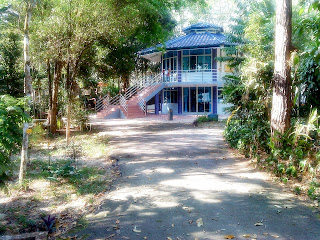

The Sima Hall
The blissful greeting at the entrance
On the day of my arrival, I met Sis Sam, the Chairperson of the centre. I was then brought by a volunteer (bro How) to my room, in which to my amusement, it was a huge room right below the Sīmā Hall! It is supposed to be the monk’s resident. Later I found out that my accomodation was arranged in such a way because the resident monk had planned to leave for Johor Bahru soon and there would be a special Burmese Vipassana meditation retreat starting on the next day and hence most rooms would be occupied.


Sister Sam is a retired teacher. As a person of utmost responsibility and commitment to the place, she seems to run the place nearly from head to toe. Somehow she was very supportive to my presence there “to practise meditation”. She got me listening to talks and Vipassana meditation instructions from the Ven Sujiva which were played from a CD. It was indeed an outright effort of hers to set things right from the beginning.

I had a chance to bump into the resident monk at Santisukharama. It was at a later period when I went back to Singapore that I got to know his name. His name is Bhante Mahacara. I had never met him before, but it seemed that there was an unknown reason of him being so enthusiastic in guiding me some basic Vipassana meditation techniques.

Basically, Santisukhārāma follows Ven Mahasi Sayadaw’s tradition which focuses on the rising and falling movement of abdomen as the meditation object. I told him that I was more familiar with Samatha and Ānāpānasati method. According to him, practising Samatha ultimately results in pure tranquility or total calmness, but Vipassana makes you “see” the interaction between body and mind, and ultimately the 3 Universal Characteristics of the whole thing which give rise to insight. Mindfulness of “in-out breath” at the nose tip could also be used, but at the end of the day, it is the sensation of the area around nostrils that matter.


"Mindfully observing the rise and fall of the abdomen..."
In my understanding from the conversation with him, it seemed to me that Mahasi’s tradition pays much attention on the body and its sensations. The technique is still very much faithful to what the Buddha had taught in Satipaṭṭhāna Sutta (The Foundation of Mindfulness). He explains to me in details the four foundations expounded in the sutta and their application in the meditation technique. My job, is to note everything that comes through: “sitting/touching sensations, pain, thinking… and so on”. Just note them mindfully, refrain from making any analysis or any further judgement.

He further elaborated on how walking meditation should be rightfully done: simply just label all movements of the feet as “raising”, “lifting”, “pushing”, “dropping”, “treading” and “pressing”. Just label them first. I was also instructed to note the “intention” to stop and change the course of my walking. “Just note the intention, and see what happens next. Everything that happens must come from an intention behind, just like the law of cause and effect. There’s no ‘I’ or ‘Me’ in your walking, it’s just the interaction between mind and matter”, those were what he told me in which I could recall.

He was so keen to guide me further, to the extent that he reconsidered his plan to leave this place. He wished to stay back to monitor my progress. I was truly overwhelmed by his noble intention, for I was doubting my own ability to follow closely his personal guidance. But when I told him that my stay was not for long, he then reverted back to his original plan of leaving for Johor Bharu.

One way or another, I always believe that when you are persisting in doing something wholesome, all the the wholesome people and things will come to support you.

My first night was a bit of a torture. I was aware that there will be no dinner served at the centre, only breakfast (at 7am) and lunch (at 11am) will be served due to the observance the 8 precepts. But I was not really prepared for that, my tummy cried the whole night and I could hardly sleep. It was indeed a regret of not sneaking in some snacks to the hermitage earlier to survive throughout the night!

“Hissing” in the midst of gentle breeze, dropping leaves like a curtain of endless length, with birds chirping “mindfully” in between the branches: thanks to the life-giving trees in the centre compound. There are so many trees, so many species, perhaps over 200 of them. Ven Sujiva quoted a cleric in his recent book: “The man who plants trees goes to Heaven.”

The Mahasi’s technique is relatively new to me. I faithfully applied the technique for my Vipassana practice there. Generally, the main distinguishing features of the approach compared to Samatha are the large extent use of body contemplation with the main object used is the “rising-faling” of the abdomen; mindful noting of each process; and walking meditation alternated with sitting, one hour at a time. I found the techniques were so refreshing, galvanising a new venture into the inner discovery for a beginner like myself.

The mindful awareness was largely paid on the rising-falling motion of the abdomen. As it is the grosser bodily activity, I found it easier to place my awareness on the object compared to the in-out breath at nostrils (the Ānāpānasati method). According the Ven Sujiva’s book, “The Tree of Wisdom, The River of No Return: The practice and development on insight meditation”, the priority of object can be changed: when the rising-falling of abdomen becomes unclear, one can switch the attention to sitting/touching sensations, or pain, or thinking processes, and the abdominal movement becomes the secondary object. The main purpose here is to keep the continuity flow of mindfullness. The instruction went on stating that one should not only keep the mind concentrated, but mindful observation on the nature of bodily sensations should also be attempted, and picked up with clear perception of the qualities of the material elements.

Usually I could sit for a full hour, unless sleepiness sneaked in, I would switch the “posture mode” to walking meditation. I discovered that sloth and torpor was the main culprit for my wandering attention, but Ven Sujiva regarded this as one of the mental energy, and should be noted mindfully. I took up the technique and found that the more I sit, the faster it was for me to pick up the “first sign” of sleepy feeling. It’s interesting to notice how it manifested and faded away with mindful attention.

Bodily painful sensation was one of my main meditation object too. When there was only minor pain, I tried to disregard it. It was so interesting to observe the changes in the degree of pain (at the knees and the ankles especially), just like watching the colours of skin when it whirls and wriggles. Impermenance… that was the first hand experience I had. However, when the pain became unbearable, I would change my sitting position, and the “intention” of doing this would be mindfully noted as well.

Walking meditation was relatively easier to be practised, especially being enveloped in such a peaceful forestry environment. Usually I started with brisk walking before slowing down the pace to deep mindful walking. Occasionally, I just engaged the feeling of being “so present” in walking. Different types of pathways were chosen, from the tiled floor to mold-covered walkways. I liked doing it in the outdoor, just loved the feelings of being entertained by the orchestra of swaying leaves and singing birds. But the main thing here was direct experience on the sensations/material qualities of the feet through mind door.

A Zen-like pathway
There were few interesting instances when I practised walking meditation. There were so many ants, big ants, outside the Sīmā Hall. Sometimes I had to change the course of my walking direction in order to avoid stepping on them or rather being bitten by them. Doing this in the middle of the mindful attention on the feet was indeed a challenge, so as not to lose my flow of mindfullness. Again, noting the “intention” was a practise to witness the work of cause and effect in mind-body interaction.


Having meals at the retreat was another interesting experience. I was arranged to be seated with the Burmese retreat participants for breakfast and lunch. There were about 100 of them, including 3 Sayadaws and 10 volunteers, all from Singapore. Watching the participants walking with an extremely mindful manner into the dining hall made me feel rather “eerie”, it was just like a scientist who had just released a new batch of “human robots”! Mainly Burmese dishes were served. As lunch was the the last meal of the day and served at the early hour of 11am, I was caught in a mind-game: “…the portion of the rice/noodle appeared too little as compared to the others”, “Hey, I like this dish, but I can’t be too selfish to gobble them all…” I just had to remind myself that this meal was only meant to conserve this body for continuity of practice. When you stop distinguishing and discriminating the food served in front of you, they somehow taste differently!
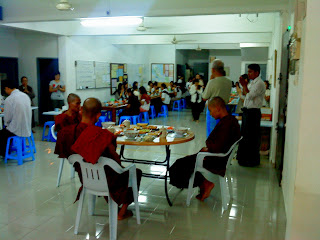
Mindful meal time with the Burmese monks and yogis

I met a few interesting people in the retreat. Apart from my presence, there was another German yogi who had been meditating on his own there about a month ago. But we rarely talked. He had a very unusual way of doing his sitting meditation: he usually did it on an armrest chair, head slanted to one side; the whole posture indeed resembled a “sleeping meditation” instead. Further, I met a friendly Burmese man, known as Zaw Tun. He seemed to be the retreat organiser. He had some useful points to share with me regarding his experience on Mahasi’s Vipassana technique. He said that Samatha helps one to develop deep concentration and traquility, and can only suppress kileṣa, while Vipassana eradicates it completely. In order to keep me up with the practice, he requested for my contact for future updates of the activities in Satipaṭṭhāna Meditation Centre in Singapore. Well, I felt there’s no harm knowing a new friend and a new “abode” for me to pursue futher practice in Singapore.

The Noble Sign
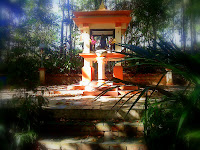
An outdoor shrine in the morning shine
The last few hours of my precious moments in the hermitage were spent with intuitive experience. In that morning, my meditation was disturbed with restless feelings, perhaps a subtle lamentation for being separated soon from this blissful abode (a kind of dukkha too). But that was later replaced with a unique absorption of a sort of “peak” experience during my sitting meditation. It felt like a blissful feeling enveloping my heart, the sensations concentrated on the base of my sitting, but the object was spread to a broader field of sensations, just like what Ven Sujiva coins as “Collected Open Awareness”, in which the awareness was kept at a fairly wide range of sensations, ensuring one practising insight on change. It was my first ever experience on the changes of material qualities of my body, a doorway to deeper insight, indeed…

An elegant Buddha-rupa

Inside Sima Hal
I concluded my trip to Kota Tinggi without a single regret. No computer, no emails, no Facebook, no TV, no Chinese New Year cookies… It is so crystal clear to me now that I was not trying to run away from my family in this festive season, or putting up an act of “anti-social animal” whatsoever. I just want to be “in the present”, a noble course for a higher goal. Though rather unconventional, I believe I was doing this for the benefit of myself and others: “Help oneself to help others; Help others to help oneself”!
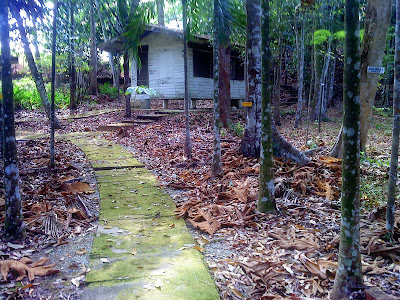

"...there's no other path more serene than the path less traveled..."

Thus have I experienced…